
Current Federal Funds Rate
4.00%
Current Prime Rate
7.00%

How are SBA 7(a) interest rates determined?
7(a) loans, like all loans, have an interest rate. This rate varies from loan to loan, but is generally within a small range dictated by the prime rate (see below). If the lender is interested in the loan, the borrower and lender will negotiate the interest rate based on the strength of the loan. At 7aSavvy, we work to connect you with the lender most interested in your loan, and thus the lender most likely to give you a favorable rate.



What is the prime rate?
The prime rate is the interest rate at which commercial banks lend money to their most creditworthy customers, which include large corporations and financial institutions. It’s based on the federal funds rate, which is set by the Federal Reserve. Typically, the prime rate is set three percentage points above the federal funds rate to cover the credit risk associated with lending to commercial borrowers.

What role does the prime rate play in SBA 7(a) lending?
The prime rate serves as a benchmark in SBA 7(a) lending, used as the basis for determining the interest rates of loans. 7(a) interest rates are described as “prime + #”, with the number typically ranging from 1.0 to 3.0. For example, if the prime rate was 7.0% and a loan’s interest rate was prime + 2.0, the interest rate for the loan would be 9.0%. Rates are determined by the quality of the loan, with safer loans getting a lower rate and riskier loans getting a higher rate. Rates come in increments of 0.25 (prime + 1.0, 1.25, 1.50, 1,75, etc.).



What is the difference between fixed and variable interest rates?
Loan interest rates can be either variable or fixed. Variable rates are pegged to an index (plus or minus a certain amount), then move when the index moves. Fixed rates are determined the same way, but stay the same for part (rarely all) of the loan term, most commonly 5 years. Fixed rates can vary more than variable rates, as fixed rates must reflect any expected movement in the index rate over the fixed period of the loan. As such, the decision on which type to seek depends on the borrower’s appetite for risk and the borrower’s and lender’s views on the likelihood and direction of future interest rate changes.

Can I get a fixed rate for my SBA 7(a) loan?
It’s possible! SBA 7(a) loan rates are usually variable. However, fixed rates can be available in some situations.



Would every lender give me the same interest rate?
No. Even for the same loan, interest rates can vary from lender to lender. The interest rate a lender offers you depends on their assessment of the loan.
Prime Rate Recent History
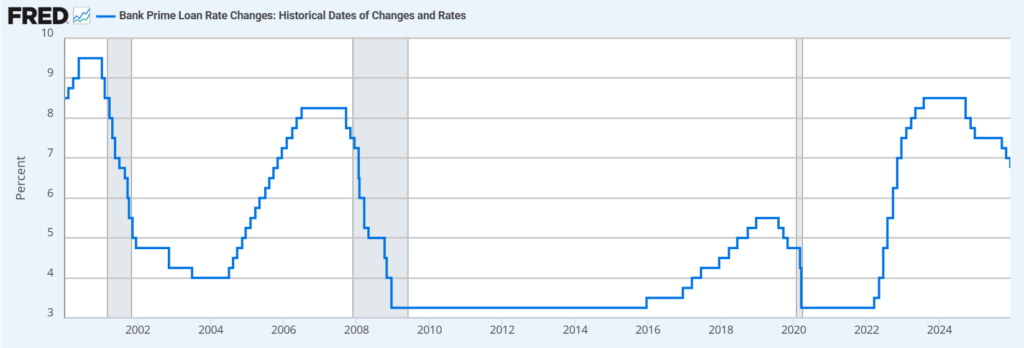
The prime rate has moved back up to 7.00%, and further increases are possible depending on how the Fed reads the economy and inflation over the coming months. For borrowers, that raises a fair question: is this a good time to take on an SBA 7(a) loan?
It really depends on the deal, not the rate environment. If the business can support the payment at today’s rate with comfortable cash flow coverage, the loan works. Waiting for rates to drop is a gamble, and in the meantime the opportunity you need funding for may not wait with you. Borrowers who passed on solid deals during previous rate cycles often found that the deal they wanted was gone by the time rates moved in their favor.
It is also worth keeping the current rate in perspective. A prime rate of 7.00% is not unusual by historical standards. The prime rate sat at or above that level for much of the 2000s, not to mention the even higher rates that were common from the 70’s to the 90’s. What was unusual was the near-zero rate environment that lasted from 2009 through 2021, and that period likely distorts how the current rate feels. Compared to most of the last 50 years, today’s rates are within a normal range.
Most SBA 7(a) loans carry variable rates, which means the rate adjusts as the prime rate moves. In a rising rate environment, that means payments can go up. Borrowers who want certainty can ask about fixed-rate options, though they are less common and may come with a higher starting rate. For variable-rate borrowers, the practical question is whether the business can handle the payment if rates move up another percentage point or two from where they are now. If the answer is yes, the deal is built on a solid foundation regardless of what the Fed does next.
The rate is one input in a much larger decision. It matters, but it should not be the reason a borrower walks away from a deal that works at today’s numbers.